
How to Set a Weekly Spending Limit (and Stick to It)
How to turn your monthly budget into a weekly spending limit, what to count in it, how to check it midweek, and what to do when you go over. With a worked example.
Short answer: a weekly spending limit is the amount you allow yourself for flexible spending each week. Subtract fixed bills and savings from your monthly take-home pay, then divide what’s left by 4.33. Check how much is left midweek, and start again every Sunday. A mistake then costs you one week, not a whole month.
A budget only helps if you look at it while you spend. In interviews and surveys, the US Consumer Financial Protection Bureau found that even people who have a budget “generally do not benchmark their spending to their budget frequently or regularly,” and over 90% of the people it talked to wanted a tool that showed where they stood at the moment of purchase (CFPB, Consumer Insights on Managing Spending, 2017). A weekly limit is the low-tech version of that feedback: a number small enough to remember and check.
Why weekly works better than monthly for everyday spending
A monthly budget is a big number. On the 5th, $1,300 for the month feels like a lot, and by the 25th it’s gone. A weekly limit fixes three things:
- The number is small enough to track in your head. “I have $120 left this week” is easier to act on than “$740 left for the next 19 days.”
- You find problems in days, not weeks. Overspend on Monday and you know by Wednesday, with four days to adjust.
- Every week is a restart. A bad week doesn’t ruin the month, as long as you handle the overspend (step 4).
Researchers call the habit of giving money a label and a limit mental budgeting: people who set budgets for categories and track spending against them can end up spending less in that category than they otherwise would (Heath and Soll, Journal of Consumer Research, 1996). A weekly limit is the same idea with a shorter clock.
Step 1: Find your flexible money
Start from a month:
- Monthly take-home pay (after tax).
- Minus fixed bills: rent or mortgage, utilities, insurance, phone, loan and installment payments, subscriptions.
- Minus savings: move it on payday so it’s gone before you start spending; see pay yourself first.
What’s left is flexible money: groceries, eating out, gas, shopping, fun, gifts, small things.
Then divide by 4.33. A year has 52 weeks and 12 months, so an average month has 52 ÷ 12 = 4.33 weeks. If you divide by 4, your weekly limit is about 8% too high, and the extra two or three days at the end of most months run over.
Worked example
| Per month | |
|---|---|
| Take-home pay | $4,000 |
| Rent, utilities, insurance, phone, subscriptions | −$2,300 |
| Savings (moved on payday) | −$400 |
| Flexible money | $1,300 |
| Weekly limit (÷ 4.33) | $300 |
Round it to a number you’ll remember. $300 a week is $43 a day, which already tells you a $90 dinner out uses two days.
Step 2: Decide what counts
Keep the weekly limit for spending that changes week to week and that you decide on the spot:
- Groceries and household items
- Eating out, coffee, takeout
- Gas, parking, rides
- Shopping, hobbies, entertainment
Keep out of it the bills you already subtracted, and big planned costs like car insurance or holiday gifts; save for those monthly in sinking funds. If they land in your weekly limit, the week they’re paid looks like a disaster even when you did everything right.
Step 3: Check midweek, not on Sunday night
The limit only works if you see it before the money is gone. Pick one fixed moment, like Wednesday evening, and look at what’s left:
- On track: spent about half by midweek. Nothing to do.
- Ahead: spent 70% or more. Skip the next takeout, plan the weekend around what’s left.
- Way under: fine, but don’t spend it just because it’s there. Leftovers can go to savings or debt at the end of the week.
To check, you need every purchase logged as it happens, card and cash alike. Card payments are the easy ones to forget; automatic payment detection can suggest them as you pay.
Step 4: Decide what happens when you go over
Pick the rule before the first bad week, not during it:
- Carry it forward: overspent $40 this week, next week’s limit is $260. The month still adds up.
- Take it from savings, on purpose: fine for a real one-off, like a friend’s wedding, as long as you name it.
- Raise the limit: if you go over three or four weeks in a row, the limit isn’t realistic. Raise it, and find the money in a fixed bill or the savings amount instead of pretending.
What you shouldn’t do is reset to the full amount every Sunday and ignore the overspend. Then the weekly limit stops adding up to the monthly budget.
Weekly limit, envelopes or 50/30/20?
They work well together:
- 50/30/20 sets the big split of your income. A weekly limit is how you live inside the “wants” and everyday “needs” part.
- Envelope budgeting gives each category its own limit. A weekly limit is one envelope for all flexible spending, which is simpler if separate categories feel like too much bookkeeping.
- Zero-based budgeting gives every dollar a job; “flexible spending, $300 a week” can be one of those jobs.
Setting a weekly limit in Japka
Japka’s Goals tab has a spending limit for this week (Sunday to Saturday), this month and this year. You set it once and it repeats on its own: every Sunday the week starts over against the same limit.
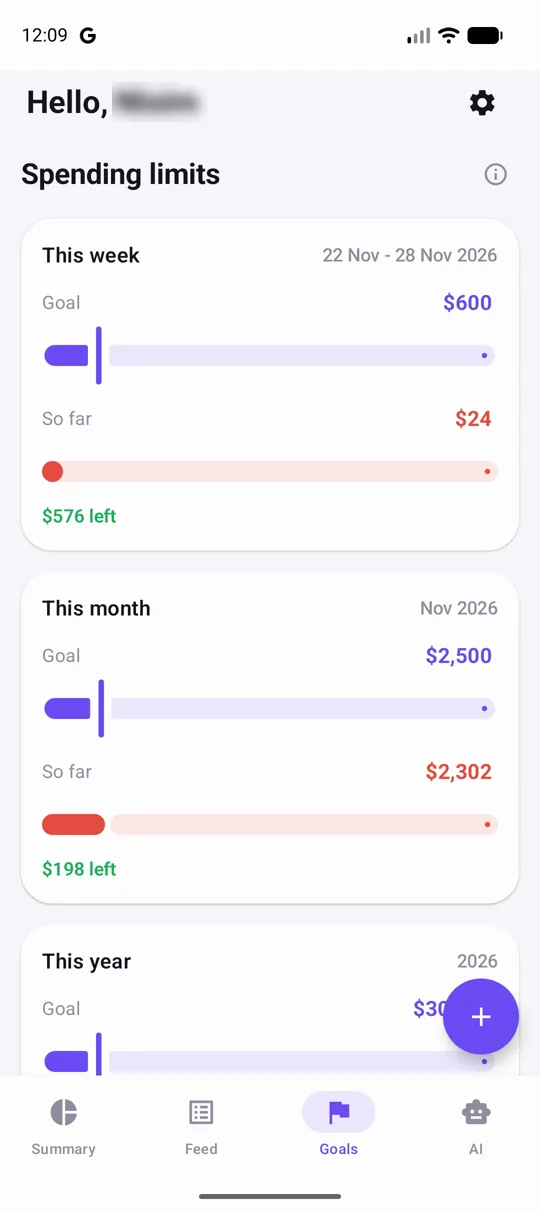
- Set the limit: drag the Goal bar or tap the amount and type it.
- Watch the second bar: “So far” shows what went out this week, and the card says how much is left, or how much you’re over.
- Reminders: on the last day of the week, month or year, Japka sends a reminder of where you stand, and the day after, how it went.
- Shared budgets: goals are shared with everyone in your shared feed, so a couple sees the same limit and the same spending.
The limit counts every expense logged that week, bills included. So the week rent or a big bill goes out will show over, and that’s expected. Set the monthly limit for your whole budget, bills included, and use the weekly card as a guide for everyday spending in the other weeks.
New to the app? Your first week with Japka covers the basics.
The bottom line
Take your flexible money for the month, divide by 4.33, and spend against that number one week at a time. Check midweek, carry over what you overspend, and raise the limit if it’s wrong rather than ignoring it. A small number you look at twice a week beats a perfect monthly budget you look at once.
FAQ
How do I calculate a weekly spending limit?
Take your monthly take-home pay, subtract fixed bills and the amount you save, and divide what's left by 4.33, the average number of weeks in a month. $1,300 of flexible money a month is a weekly limit of about $300.
Why divide by 4.33 and not 4?
A year has 52 weeks and 12 months, so a month has 52 ÷ 12 = 4.33 weeks on average. Dividing by 4 makes the weekly limit too high, and the extra days at the end of most months go over budget.
Should rent and bills count toward a weekly limit?
Usually not. Bills are the same every month and often land in one week, which makes that week look like a failure. Keep the weekly limit for flexible spending like groceries, eating out, gas and fun, and keep bills in the monthly budget.
What if I go over my weekly limit?
Don't treat the next week as a fresh start with the full amount. Either take the overspend from next week's limit, or decide on purpose that it comes from savings. If you go over most weeks, the limit is too low; raise it and cut a fixed bill instead.