
How to Budget Purchases Paid in Installments
Installments make a big purchase feel small. How to record a payment plan so each month shows its real cost, spot interest, and see what's still owed.
Short answer: treat every installment plan as a fixed monthly bill. Record the purchase once, split it into equal monthly payments, and count each payment in the month it is due. Your budget then shows what you really pay each month, not one scary spike followed by months of “free” money.
Key takeaways
- An installment plan is a loan, even at 0% interest. Paamonim, the Israeli budgeting nonprofit, says so in plain words.
- Count each payment in its own month, not the full price on the purchase day.
- In Israel, “tashlumim” from the shop are often interest-free, while “kredit” from the card company adds interest. Ask which one you’re getting.
- Before a new plan, add up what earlier plans already take from next month’s income.
Why installments break most budgets
In Israel, paying in installments (tashlumim) is offered for phones, furniture, flights and much more. Elsewhere it’s called “buy now, pay later” (BNPL) or a payment plan. It feels painless, and that is exactly the problem:
- The purchase disappears. After the first month you forget it exists, but the card keeps charging.
- Plans stack up. Four small plans of ₪200 are ₪800 a month of income that is already spent.
- The wrong month looks bad. If you log the full price on the purchase day, that month looks terrible and the next eleven look better than they are.
Stacking is common. In a study of six major US BNPL lenders, the Consumer Financial Protection Bureau found that about 63% of BNPL borrowers took out several loans at the same time during 2022, and 33% borrowed from more than one lender (CFPB, January 13, 2025). That data is American, but the mechanism is the same on an Israeli credit card: each plan is small, and together they quietly fill your month.
Paamonim, the Israeli nonprofit for household budgeting, warns that when buying in installments becomes a habit, the small amounts add up to sums that are hard to pay, and that everyday purchases such as supermarket shopping shouldn’t be split at all (Paamonim, managing credit cards, in Hebrew).
Tashlumim vs kredit: check for interest first
Two different things hide behind “pay in 12”:
| Installments (tashlumim) | Credit (kredit) | |
|---|---|---|
| Who offers it | Usually the shop | The card company |
| Interest | Often none, but not always | Yes, it’s a loan |
| What to record | The total price | The total you will actually pay, including interest |
Paamonim’s advice is simple: before an installment purchase, find out whether interest is charged. It also notes that with a bank-issued card, the whole purchase counts toward your credit obligations right away, even when it’s paid in installments (Paamonim). In practice, a ₪3,600 laptop in 12 payments can use ₪3,600 of your credit line on the first day, not ₪300.
The right way to record an installment purchase
Say you buy a ₪3,600 laptop in 12 interest-free payments on October 14.
| Payment date | What you record |
|---|---|
| October 14 | ₪300 (1/12) |
| November 14 | ₪300 (2/12) |
| … | … |
| September 14, next year | ₪300 (12/12) |
Each month carries ₪300. Your October summary is honest, and in March you can still see that ₪300 of your income goes to the laptop.
Your card company charges each payment on your billing date, not on the 14th. That’s fine. Your budget runs on the spending month, and the billing date only matters for cash in the bank; see why your card billing date makes the month look wrong.
How to add installments in Japka
- Tap + to add a transaction and keep it on Expense.
- Enter the full price (₪3,600), pick a category and fill in For, such as the shop or item.
- Tap Installments and choose the number of payments, from 2 to 36.
- Tap Save Transaction.
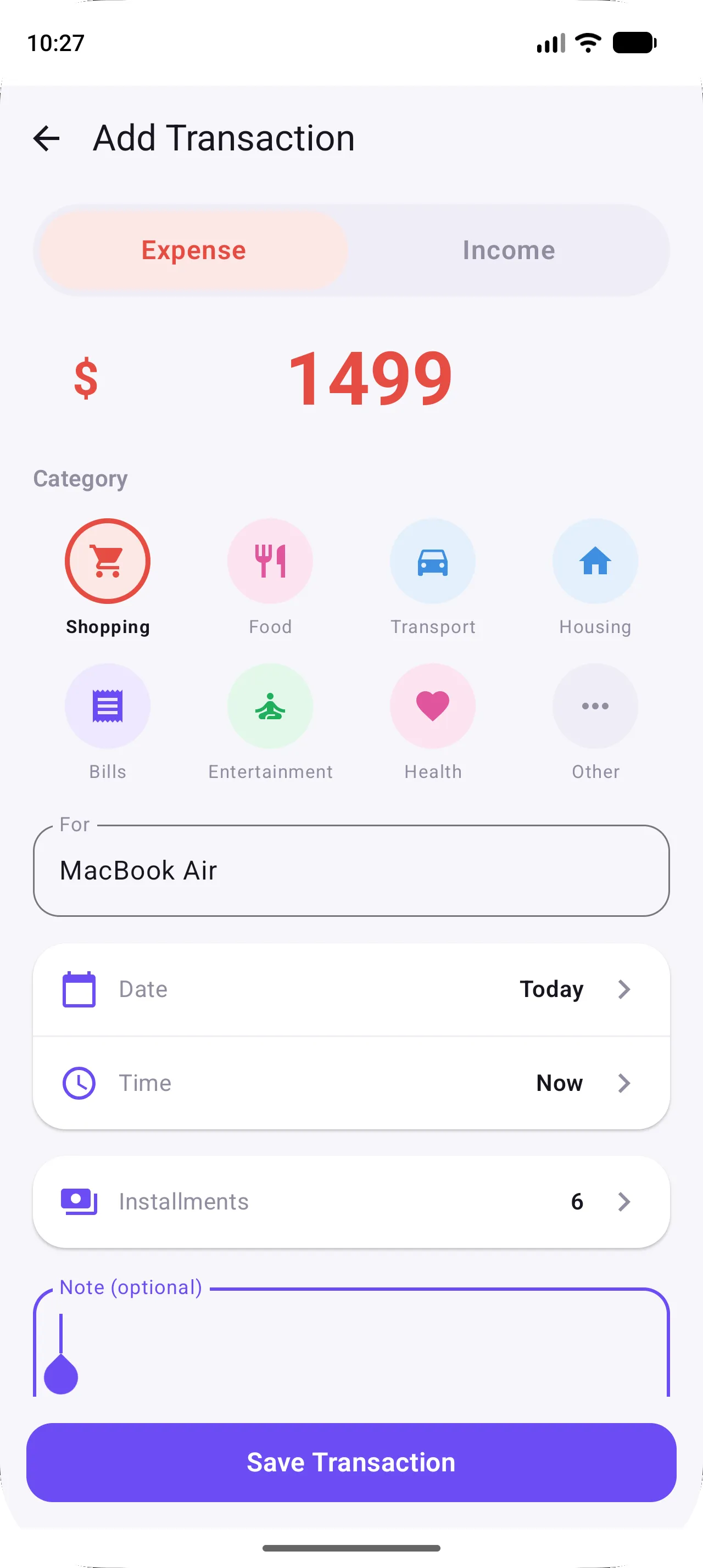
Japka divides the total equally and creates one payment per month on the same day of the month as the purchase. If you buy on the 31st, months without a 31st get the payment on their last day. The first payment counts now. The rest are scheduled and stay out of the feed and Summary until their date arrives, so this month’s totals show only what is actually due this month.
Each payment in the feed shows its number, like 3/12, and how much you’ve paid so far out of the full price, like ₪900/₪3,600. Returned the item or got the count wrong? Open any payment of the plan: editing changes the whole series, and deleting removes every payment at once, instead of hunting down twelve separate entries.
Know your monthly commitments
Before you agree to another payment plan, ask one question: “How much of next month’s income is already spent?”
Add up every active installment plus your fixed bills (rent, utilities, subscriptions). Compare that with your take-home pay. The 50/30/20 rule gives about half of income to needs, and installments eat into whichever bucket the purchase came from. If committed money already fills most of your needs share, a new plan squeezes everything else, even at 0% interest.
In Japka, the latest payment of each plan tells you where you stand: ₪900/₪3,600 means ₪2,700 is still to come. Add the remaining payments of your active plans to next month’s fixed bills, and you know how much of next month is spoken for.
Tips for using installments wisely
- Use them for things that last longer than the plan. A laptop over 12 months is reasonable; a dinner over 3 months is not.
- Never split everyday spending. Groceries in installments mean next month starts in debt.
- Prefer fewer payments. Shorter plans free up your income faster.
- Record the real total. If the plan charges interest or fees, enter what you will actually pay, not the sticker price.
- Don’t let installments hide a shortfall. If you can’t afford something without splitting it, that is useful information. Saving first and buying later costs nothing.
Summary
Installments are a monthly bill in disguise. Check whether the plan charges interest, record the total once, split it across the months it’s actually due, and keep an eye on how much of your future income is already committed. Japka, a budget planner and expense tracker that works without a bank connection, does the splitting for you, so every month in your summary reflects what it really costs. New to tracking? Start with tracking expenses without a bank connection.
This guide is general information, not financial advice. Your card agreement and the shop’s terms set the actual interest and fees.
FAQ
How do I track a purchase paid in installments?
Record the full price once and split it into monthly payments. In Japka you enter the total, choose the number of installments (2 to 36), and the app creates one payment per month on the same day, each showing its number, like 3/12.
Should installments count as an expense when I buy or when I pay?
When each payment is due. Counting every payment in its own month shows your real monthly spending and stops one big purchase from distorting a single month.
Are installments the same as debt?
Yes. Paamonim, the Israeli household-budget nonprofit, calls installments on a credit card a loan in every sense. Interest-free plans are still a commitment of future income, so they belong in your budget for every month they cover.
What is the difference between installments (tashlumim) and credit (kredit) in Israel?
Regular installments are usually offered by the shop and are often interest-free. Kredit is a loan from the card company that splits the charge and adds interest. Always ask which one you are getting before you agree.
How do I see how much I still owe on an installment plan?
In Japka every installment payment shows how much you have paid so far out of the full price, for example ₪900/₪3,600 next to 3/12. The difference is what is still to come.