
How to Set a Monthly Income Goal for Freelancers
How much to earn each month as a freelancer or with side income: costs, savings, taxes and slow months, turned into a weekly target.
Short answer: an income goal starts from what you need, not what you hope. Add your monthly living costs and savings, then divide by the share you keep after taxes and business costs. That’s your monthly goal. Multiply it by 12 and divide by 52 for a weekly target, and check it every week, while there’s still time to find more work.
If your pay isn’t a fixed salary, a goal matters more. In the Federal Reserve’s 2025 survey of US households, 58% of self-employed adults said their income varied from month to month, compared with 30% of all adults (Federal Reserve). Without a target, it’s hard to tell a slow month from a problem.
This guide is about the earning side. For how to spend steadily on income that changes, see how to budget on an irregular income.
Step 1: Add up what you need to live
List one normal month of personal costs:
- Fixed: rent or mortgage, utilities, insurance, phone, loan and installment payments, subscriptions.
- Everyday: groceries, transport, eating out, kids, personal spending.
- Irregular, averaged: car repairs, gifts, annual fees; divide the yearly total by 12, as in sinking funds.
If you already track spending, use the real average of your last 3 months, not a guess.
Step 2: Add savings
Add what you want to put aside each month: an emergency fund first, then retirement and goals. On variable income, the buffer for slow months comes first; build toward one to three months of costs.
Living costs + savings = what you need to take home.
Step 3: Add taxes and business costs
You don’t keep every dollar you earn. Work out the share you keep:
- Taxes: in the US, self-employment tax is 15.3% (Social Security and Medicare) on net earnings of $400 or more, on top of income tax (IRS). Other countries have their own social security and tax rates; an accountant can tell you your real share.
- Business costs: software, equipment, platform fees, insurance, travel.
Then:
Income goal = what you need to take home ÷ share you keep
If taxes and costs take 30%, you keep 70%, so you divide by 0.7. Divide, don’t add 30%: adding 30% to $3,600 gives $4,680, and 70% of that is only $3,276.
Worked example
| Per month | |
|---|---|
| Living costs | $3,200 |
| Savings (buffer first) | $400 |
| Need to take home | $3,600 |
| Share kept after ~30% for taxes and costs | ÷ 0.7 |
| Monthly income goal | ≈ $5,150 |
| Weekly target (× 12 ÷ 52) | ≈ $1,190 |
| Yearly goal | ≈ $61,800 |
If you bill by the hour, divide the monthly goal by the hours you can really bill. Not every working hour is billable: admin, finding clients and unpaid gaps take time. At 80 billable hours a month, $5,150 is about $65 an hour.
Step 4: Break it into weekly targets
A monthly goal tells you on the 30th whether you made it. A weekly target tells you on the 7th, while you can still act:
- Behind after week 1 or 2: follow up on unpaid invoices, contact past clients, take the smaller job you were going to skip.
- Ahead: don’t raise your spending. Move the extra to your buffer first.
Use monthly goal × 12 ÷ 52, not monthly ÷ 4. A month has 4.33 weeks on average, so dividing by 4 sets the weekly target about 8% too high, and you’ll feel behind when you aren’t.
Step 5: Judge the year, not one month
On variable income, some months will miss. That’s normal if the year adds up. Set a yearly goal next to the monthly one, and look at it every month:
- A slow month followed by a strong one is fine.
- Three slow months in a row is a signal: raise prices, find more clients, or cut costs, before the buffer runs out.
Setting an income goal in Japka
Japka’s Goals tab has income goals for this week (Sunday to Saturday), this month and this year, next to the spending limits. You set each goal once and it repeats on its own every week, month or year.
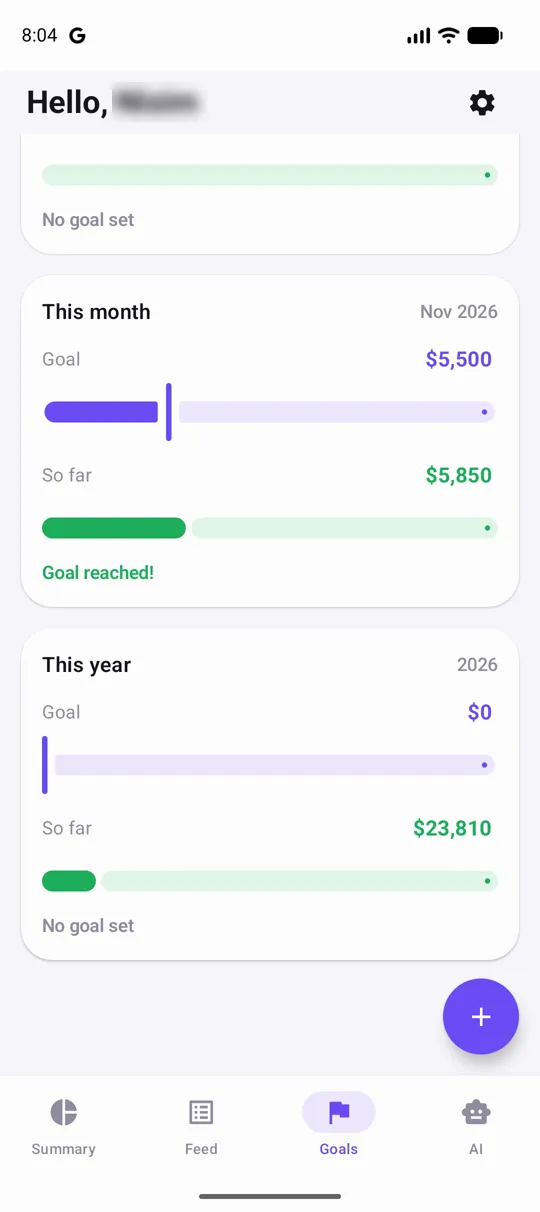
- Set the goal: drag the Goal bar or tap the amount and type it.
- Watch “So far”: income you log counts toward the goal, and the card shows how much is still to go, or “Goal reached!”
- Reminders: on the last day of the week, month or year, Japka reminds you where you stand, and the day after, how it went.
- Log income when it’s paid: add each payment as income on the day it arrives, so “So far” shows money you actually have, not invoices.
New to the app? Your first week with Japka covers the basics.
The bottom line
Work backward from what you need: living costs plus savings, divided by the share you keep after taxes and costs. Turn the monthly goal into a weekly target, check it every week, and judge your progress over the year, not one month. A clear number turns “I hope this month is good” into “I need $1,190 more this week.”
FAQ
How do I calculate a monthly income goal?
Add up your monthly living costs and the amount you want to save. That's what you need after tax. Then divide by the share of income you keep after taxes and business costs. If you need $3,600 and keep 70% of what you earn, your goal is $3,600 ÷ 0.7, about $5,150.
How much should freelancers set aside for taxes?
It depends on your country and income. In the US, self-employment tax alone is 15.3%, on top of income tax. Many freelancers set aside a fixed share of every payment, often 25% to 30%, and adjust it with an accountant.
Should I set a weekly or a monthly income goal?
Both help. The monthly goal is the one your budget depends on. A weekly goal, the monthly goal × 12 ÷ 52, tells you early in the month whether you're on track, while there's still time to find more work.
What if my income is different every month?
Set the monthly goal from your costs, not from your best month, and add a yearly goal too. A slow month is fine if the year is on track. Keep a buffer of one to three months of costs for the gaps.